
Umberto Eco and Abulafia's Revenge
Part 1: Prophetic parodies
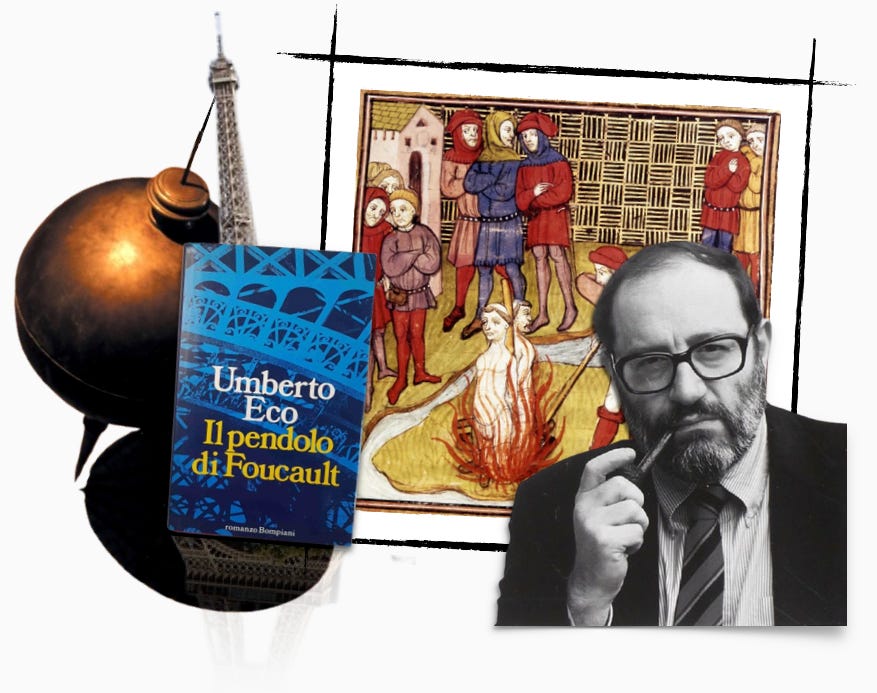
Today I realize that many recent exercises in “deconstructive reading” read as if inspired by my parody. This is parody’s mission: it must never be afraid of going too far. If its aim is true, it simply heralds what others will later produce, unblushing, with impassive and assertive gravity.
Umberto Eco, in Misreadings (1993)
In the final year of his life, as he was promoting his seventh novel, Numero Zero (2015), Umberto Eco struck some unusually somber tones with the audiences that he met on his European book tour, issuing dire warnings about things to come. At the University of Turin – the institution that had awarded him his PhD sixty years earlier – he was given an honorary doctorate for his work in “communication and media culture”, but the man who had so often defended popular culture against the jeremiads of the ‘apocalytic intellectual’ now had nothing positive to say about the most recent addition to media culture: the rise of social media. The whole event was a bit odd. Indeed, when he sat down to meet the press, Eco immediatly launched into a headline-grabbing rant about the “the tragedy of the Internet”, and how it had “promoted the village idiot as the bearer of truth.” The apocalypse was actually maybe coming. Serious newspapers, he argued, now that they were rapidly losing their role as gatekeepers of the public discourse, had to adapt and become cultural fact-checkers, dedicating several pages of every issue to disproving what hoards of idiots had been saying online the day before.
Undoubtedly, this was the lament of an aging man – and perhaps particularly the lament of a distinguished man of letters, who had lived and breathed the culture of the printed word like few others. As such, it could easily be dismissed (as it indeed was) as the groan of a dying dinosaur, peering into a digital abyss and seeing not only his own demise but the extinction of his entire species, with social media appearing on the horizon as a giant comet of nonsense that was going to cast all of us into a new age of darkness.
Warning This essay contains several instances of scatological language. While this is somewhat unfortunate, it is arguably appropriate in an essay about Umberto Eco, who famously drew quite a number of his metaphors and philosophical examples directly from either end of the male perineum.
Ten years after Eco’s death this kind of criticism has become so widespread that it is almost tedious, just another doom-mongering message in a never-ending news feed, but in 2016 it was still uncommon, back when the world was yet to experience the shocks of Brexit and Trump and Covid-19, if not to mention the horrors of a Facebook-fuelled genocide against the Rohingya Muslims in Myanmar. It was of course also before the purchase of Twitter by the world’s wealthiest man and the subsequent ‘enshittification’ of this and many other online platforms, a process of internet decay that, according to Cory Doctorow, inevitably ensues the relentless attempt to capture eye-balls and monetise our attention for the benefit of lining the pockets of a few billionaires. In the case of Twitter, moreover, the process of decay was significantly accelerated by Elon Musk’s decision to meddle with the algorithm in various ways that would entrench his counter-conspiratorial coup against the threat of Wokery, a case of aggravated ‘enshittification’ that arguably deserves its own special category on the scatological scale of decay. Perhaps ‘X-crementtification’ will do?
Before the visible onset of these ills, social media was generally seen as a network rather than a platform, – as a free, if at times frivolous, escape into an online world of unlimited interconnectedness, where the worst that could happen was that your granny would see you tagged in an embarrassing photo from a boozy night out. In the world of politics, moreover, social media was often portrayed as a benign force for improving democratic engagement, having been a decisive factor in creating the wave of popular excitement that sent Barack Obama into the White House in 2008. Indeed, it was heralded as a potentially subversive weapon in the democratic armoury everywhere, enabling protesters to coordinate in ways undetected by authoritarian governments, undetected until the moment when they all erupted into the Tahrir Square (or Bourguiba Avenue, or the Maidan Square, etc). After the events of 2016, however, all of this optimism began to vanish. What had begun as small, independent streams of discontent suddenly converged into a torrent of criticism, reaching an initial high-water mark when the term ‘fake news’ briefly emerged as the go-to explanation for all our political ailments; indeed, ‘fake news’ was named the word-of-the-year in 2017, only a few months after Donald Trump bizarrely claimed to have invented it, presumably during one of his late-night Twitter tirades against the mainstream media. A truly absurd claim, of course, and a staggering case of ironic hypocrisy to be sure, but also a prime example of the President’s now all-too-familiar signature act of ‘confessional projection’ – of accusing his accuser of doing exactly what he is accused of doing. Like the crackpot calling the kettle cracked.
And the kettle was of course at little cracked. In that same year, social media feeds the world over were awash with stories from more or less reputable sources about how the results of both the US election and the UK referendum had been corrupted by nefarious outside forces, with the so-called “Steele dossier” lending credibility to the idea that Trump was a Manchurian candidate, and with the small tech start-up company Cambridge Analytica emerging as a popular scapegoat for Brexit in the UK, accused of providing large swathes of ill-begotten data to the Vote Leave campaign, who then ostensibly used it to mow down the marginal voter with some highly targeted bullet-points. Despite extensive scrutiny by the established media, the proof of these instances of foreign and/or illegal interference proved to be very thin or non-existing, yet the stories continued to spread online, only to be absorbed into the general melée of madness unleashed in 2020, when everyone suddenly found themselves locked in their homes and glued to their screens. We all remember how this annus horribilis unfolded, oscillating as it did between self-isolation and public demonstrations, with protesters marching down emptied streets, and with the year reaching some kind of mad conclusion with Trump’s ‘stop the steal’-campaign, agitating the bowels of the internet to flood the zone with shit and fomenting a riotous stampede on the US Capitol, which ended not with a whimper but with a fatal bang, echoing violently – along with the strange groans of the QAnon shaman – down the battered and shit-smeared corridors of Capitol Hill.
The bigger story behind all these maddening events, as we are perhaps now more aware, is not so much one involving legal culpability or a smoking gun, but a more complicated one about institutional and cultural decay; about the cynical exploitation of grievances for political and pecuniary gain, and above all about the human propensity to lie and be lied to – to invent and believe stories that are false but which feel like the truth, or feel like the truth is supposed to feel, like something that makes us feel good. Nobody is immune from this.
Umberto Eco knew this better than most people. Not only was he the most well-read man in Europe by the time of his death, with a private library in Milan of more than sixty thousand books, but he was also an Italian whose life was book-ended by two figures of impeccable mendacity: Benito Mussolini and Silvio Berlusconi. In Numero Zero, Eco cleverly fitted both of these men into a satirical narrative about the state of Italian journalism. Set during two months in 1992, the novel revolves around an experimental daily newspaper called Domani, whose aim it is to speculate about tomorrow’s events rather than to do the hard investigative work of reporting what actually happened the day before. Like all Italian news media, Domani is in private hands, owned by the shady celebrity businessman and TV mogul Commendator Vimercate, a character who is, quite evidently, a thinly veiled fictional version of Signor Berlusconi, the shady and lecharous businessman from Lombardy who entered Italian politics in 1994 as the leader of Forza Italia, helped immensely by the cultural purchase his vast media empire, and whose private residence (one of many) was located in the commune of Vimercate, situated to the North-East of Milan. To oversee this experiment in conjectural journalism, Commendator Vimercate has hired the cynical and self-serving newsman Simei, who in turn commissions the book’s narrator, Colonna, to be the ghostwriter of his planned memoirs about this noble attempt to lead Domani to success, an attempt that Simei knows will fail, because he knows the true purpose of Domani, which is not to inform the public or gain readers but instead to insinuate about politicians and financiers in order that Vimercate can intimidate his way into their inner citadel of power.
To help him with this, Simei puts together an eclectic team of writers, a motley crew of largely failed academics (like Colonna), whom he then instructs to produce twelve dummy issues, or “zero issues”, in the hope that this will suffice to achieve the big boss’s true objective. In this way, and without Domani ever being properly published, everyone gets what they want, from Vimercate to Colonna and all the way down to the failed academics, who get a few months’ worth of cash in exchange for their trouble. (Incidentally, these academics are “failures” because they never graduated from university. If the novel had been written today, they would of course all have stellar PhDs).
One of these hired hands is called Braggadocio, and as the name suggests, he understands the assignment a little too well and naturally takes it all too far for everyone’s good. His desire to deliver a genuine scoop leads him down a paranoid path that reveals a vast fascist conspiracy hiding just below the surface of Italian society, a conspiracy that ends up encompassing virtually every major violent event of Italy’s recent history, from the Piazza Fontana bombing in 1969 to the Bologna Massacre in 1980 and so on. Crucially, at the heart of the conspiracy he uncovers a big secret: that the man who was shot by communist partisans in April of 1945, and subsequently beaten to a pulp and hung by his feet (next to his mistress) from a metal girder in Milan, was not in fact Mussolini, but instead his unfortunate body-double. Since then, the potential return of Il Duce had been a credible prospect for all those fascists lingering within the corridors of the still largely un-purged Italian state, and especially within the clandestine paramilitary outfit known as Stay Behind or, as it became known after Prime Minister Andreotti’s revelations in 1990, Operation Gladio - a sleeper-cell of guerrilla operatives covertly established in many NATO countries in the 1950s, ready to rush into action in case of a Soviet invasion.
In short, Braggadocio believes he has uncovered the key that unlocks the mystery behind some of the most painful and confusing events of Italy’s turbulent post-war history, the period known as the ‘Years of Lead’, thus exposing the official story of bipartisan extremism as a web of convenient lies, designed to obfuscate the giant black spider hiding at the centre, the un-dead Mussolini and the long shadow of fascism, extending its ugly grasp all the way from the Vatican and far into left-wing terrorist groups. For instance, the kidnapping and subsequent murder of the former Prime Minister Aldo Moro, which the Red Brigades ruthlessly carried out in 1978, was in fact a false flag operation, orchestrated by a secret, CIA-funded fraternity of old fascists, whose past activities were quickly forgiven in Washington and Rome in exchange for their militant anti-communism and useful mafia ties. Similarly, the aborted coup d’état of December 1970, the so-called Borghese Coup [Golpe Borghese], was in reality part of a larger plan to bring back Mussolini from exile, a plan that was ultimately foiled, not by Junio Valerio Borghese’s famous loss of courage, such as the official story had it, but by the natural and coincidental death of the inbound Il Duce, without whom the plot could not realistically go ahead.
If all of this is confusing to you, leaving you clueless about what actually happened, then this is probably also what was intended by Eco. Indeed, this carefully mixed concoction of truth and falsehood seems designed to induce a sense of vertigo in the reader, perhaps even a taste of the same paranoia that Braggadocio succumbs to and bequeaths to the narrator, Colonna, whose sanity is only somewhat restored at the end of the novel by the combined intervention of his love-interest, the autistic journalist Maia, and a chance exposure to a TV programme from the BBC, bursting through the corporate airwaves of Italy – like a public service announcement from God himself. Indeed, Eco has structured the narrative in such a way that the novel’s and the narrator’s paranoia reaches a conspiratorial crescendo on the exact same day in 1994 when Italian TV aired a more than two-hour long BBC documentary about Gladio and Stay Behind, featuring interviews with many of the key people involved. This adds a much needed tonic to Braggadocio’s potent gin, sobering up the narrator’s mind just enough for him to realise that much of what he had been told was in fact perfectly true, but intermixed with an awful lot of pure invention too, and with none of what was true actually being news, let alone a scoop. All one had to do was to apply one’s own critical faculties, together with one’s long-term journalistic memory, something which the contemporary Italian media environment militated against (hence the satire of Domani).
Surprisingly, then, the novel’s antidote to Colonna’s paranoia is autism and the BBC, the former ostensibly because Eco believed it made one immune to collective delusions, the latter presumably because of its status as a widely respected, well-funded public institution, with a strong journalistic ethos of impartiality, trimming down conjectures to what the evidence can support. However, an alternative reading is also possible, a much more pessimistic one, one that sees the ending as a dark revelation that the contagion has spread even to the BBC, which then becomes a kind of superspreader of paranoia. After all, the documentary about Gladio consists mostly of interviews, pitting word against word, hearsay against hearsay. On this reading, then, the only hope that Eco leaves us with is the intellectual virtues of the quirky or autistic individual, whose hardwired aversion to group-think allows her to maintain a critical perspective and a sense of reality in a culture that has succumbed to the eternal present and the more or less paranoid pursuit of easy, entertaining and ever-expanding connections.
Numero Zero was Eco’s last attempt at conveying one of his key insights about conspiracy theories, or ‘paranoid interpretations’ as he often called them, namely that they are epistemically infertile and socially disempowering, delivering cheap psychological gratification in the form of a convenient or exciting conjecture that is impervious to falsification or simply remains impotent as a theory by never being subjected to the cumbersome and often costly process of fact-checking. As such, they often produce a kind of conservatism by default, a kind of inadvertent shadow boxing, being incapable of landing a proper punch because the journalistic leg-work is shoddy and unsupported.
The novel was also an opportunity for Eco to divulge quite a lot of the sub-standard tradecraft that he had observed during a lifetime of writing for Italian newspapers, everything from how best to feign objectivity to how to drum up a sensational news story from absolutely nothing at all. Interestingly, this sometimes involves phoning up unsuspecting academics to get them to confirm things that nobody has thought to deny, thus enabling headlines such as “Historian Confirms: Caesar was assassinated!”). Today, the same headline would of course be rendered in an even more irritating way, generating the maximum amount of “engagement” (to satisfy some algorithmic overlord) with the bait of an empty secret: “Historian Reveals: You’ll Never Guess What Happened to Caesar on the Ides of March!” Somewhat depressingly, the innovation of the ‘click-bait’ headline, which ever since Eco’s death has made continued incursions into even quite reputable newspapers, seems like a direct commercial application of a central semiotic insight of his about the allure of the ‘empty secret’, the secret that announces itself as such but which hides nothing but its own emptiness; a naked act of concealment that superficially irks and stirs the human desire for meaning, only to then leave it unsatisfied and deflated, like a broken promise, or like a one-night-stand that was supposed to have meant something more.
Despite its evident stupidity, then, the effectiveness of this journalistic nuisance would not have surprised Eco at all. In Foucault’s Pendulum, his second novel from 1988, he made his unfortunate narrator come to the belated realisation that “the whole world is an enigma, a harmless enigma that is made terrible by our own mad attempt to interpret it as though it had an underlying truth.” For Eco, the fundamental tragedy of the human condition is that our meaningless universe is sending us mixed signals, that its lack of meaning is not simply apparent or announced but concealed behind a veil of evocative signifiers, all lining up in a promiscuous chain of connections, spinning like a cosmic carousel of click-bait, repeatedly taking humanity for a ride around a hidden void, around the hermeneutic equivalent of a black hole, the horror vacui of meaning.
Numero Zero also allowed Eco to engage once more with one of his favourite themes, the historical influence of lies and forgeries, which in the case of Operation Gladio involved the question of the authenticity of the so-called Westmoreland Field Manuel, a document that most historians consider a Soviet forgery, but which allegedly – to those who believe – proves the existence of a CIA-backed “strategy of tension”, according to which violent attacks would be carried out and then blamed on various communist factions, all in order to justify government suppression of radical left-wing politics during the Cold War. To a considerable degree, the history of the world, Eco believed, could be told as the unintended effects of certain influential lies or forgeries, forgeries which often began their life as little more than a joke or a convenient little story. The Donation of Constantine, for instance, which rendered onto the Pope all authority over Rome, was of course a fraud, as Lorenzo Valla’s philological analysis had demonstrated to the Renaissance, but Eco was convinced that it had begun as a mere rhetorical exercise that only over time was taken seriously as an authentic 4th century document. Nonetheless, by being taken seriously, it produced centuries of genuine conflict over investitures and the control of the Holy Roman Empire. Lies, in other words, often took on a life of their own and could all-too-easily spiral out of control, producing effects that nobody intended. Insofar as Eco had a philosophy of history, it was something like this. Indeed, his books and novels abound with examples of influential forgeries, ranging from the mysterious, twelfth-century letter of Prester John, suggesting the existence of a Christian kingdom hidden somewhere beyond the muslim world, to the Protocols of the Elders of Zion, an anti-semitic hoax from 1903, purporting to reveal the invisible hand behind seemingly unconnected historical events and exposing a supposed Jewish plot for global domination. This last forgery, the Protocols, whose complicated origin story Eco returned to again and again, was merely an extremely influential instance of a mode of thinking about the world that was depressingly common in modern society, Eco believed, one that had survived the Western process of secularisation unscathed by substituting the sinister plots of powerful men for the divine conspiracies devised in heaven or hell (or on top of the Olympus), all of which frustrating the well-laid plans of mere mortals, who then comforted themselves by telling false tales about the source of their misfortune. Borrowing from Karl Popper, Eco referred to this as the idea of a ‘cosmic’ or ‘universal conspiracy’, the pervasiveness of which stemmed in part from its highly movable target – a target that nonetheless very often, alas, turned out to be the jews.
Karl Popper had coined the term ‘conspiracy theory’ in 1948, essentially as an afterthought to his critique of totalitarianism in The Open Society and its Enemies (1948), an afterthought that he then incorporated into the book’s second edition. There, he categorised conspiratorial thinking as the product of the same erroneous understanding of society that also informed ideas about economic planning and totalitarian governance. Essentially, the conspiracy theorist believed that it was possible for a small group of people to effectively manipulate society in a way that produced a predictable outcome. History, however, showed that real conspiracies rarely succeeded in doing this; that they were repeatedly undermined by the unforeseen and undesired consequences of their own actions, much like the economic planner was. Popper had by this point read F. A. Hayek’s contributions to the so-called ‘socialist calculation debate’, and he had absorbed Hayek’s central idea of society as a spontaneous order, emerging through the uncoordinated actions of individuals pursuing their own interests. For Popper, this explained why conspiracies so often failed, operating as they did on a false idea of how society works, or at least how a liberal or open society works. Interestingly, Popper also considered the idea that conspiracy theories could be indirectly self-fulfilling, that is, that they could engender real counter-conspiracies that would then end up emulating those imaginary conspiracies they were intended to oppose. Popper called this the Oedipus Effect, and he saw the Protocols as a paradigmatic example of this, adding some high-octane paranoia to a continent that was already fired up by anti-semitism, thus preparing the ground for National Socialism, a conspiratorial counter-conspiracy if there ever was one, bent on global domination no less than their imaginary enemy.
This idea had a profound influence on Eco, who came to see the counter-conspiracy against an invented enemy as one of the main ways in which conspiratorial thinking could cause real harm in the world, especially in a society that doesn’t have the cultural or institutional strength to resist the siren call of the easy omni-explanation, leaving the paranoia free to reverberate louder and louder as it rebounds back and forth from one extreme of the political spectrum to the other, eventually reaching a fever-pitch of fanaticism that then inevitably finds an outlet in violence.
Numero Zero was a warning. It was a dramatisation of the inherent asymmetry that exists between the ease of making connections and the practical and psychological expense involved with the attempt to rigorously test them against the evidence. Seen as a contest, it is profoundly rigged by human nature, requiring huge corrective measures put in place by society to create a somewhat level playing field, something which Italy was particularly bad at doing, not because it was “behind” other Western countries in this regard but more likely because it was ahead. Italy was, Eco feared, a bellwether for political and journalistic developments elsewhere. And as such, the novel was not simply a parody of Italian journalism but yet another instance of that kind of parody that Eco seemed cursed to produce in uncanny numbers, the prophetic parody, presenting the rise of Berlusconi as the outcome of an increasingly shallow and commercial media culture, one that brings in its wake a fair number of Braggadocios, each of whom motivated by their own unique blend of cynicism and self-delusion. Take your pick among today’s many contenders, among today’s long line-up of charlatans, all of whom vying for your attention and time, all of whom available on your favourite podcasting app and for only £10 a month you can get full access to their views about the medical benefits of Ivermectin, the real villain of WWII, or perhaps the true cause of the war in Ukraine. Like Eco’s Braggadocio, they always chew a whole lot more than they can journalistically bite off, and they thrive in a society where nothing is absorbed, nothing is digested, where everything is just endlessly chewed over and over, only to be spat out and instantly forgotten. Occasionally, of course, they strike gold and more or less accidentally alight on a solid story that conventional media outlets refuse to touch. Sometimes, the kettle is indeed very broken. The initial coverage of the question about the origin of Covid-19 – whether it was a lab-leak or a zoonotic desease – is certainly a cautionary tale, just like the whole story about Gladio was in Eco’s Italy.
Note: Eco’s character of Braggadocio was probably based on the Swiss-Italian journalist and now discredited academic Daniele Ganser, whose controversial book NATO’s Secret Armies: Operation Gladio and Terrorism in Western Europe (2004) caused a bit of a stir in the mid-2000s, a controversy that undoubtedly provided fodder for Eco’s imagination. Since his final expulsion from academia in 2017, Ganser has built a massive following on Facebook and YouTube, becoming one of the best known conspiracy theorist in the German speaking world. As he proudly boasted in 2021: “Someone is watching one of my videos at any given time, 24/7, even right now.”
Like many Italians of his generation, Eco regarded the BBC as a beacon of seriousness and objectivity, as a public institution liberated from the profit motive and bound by a public commitment to persuing the truth. But more generally, he looked to Britain herself as a bastion of moderation and common sense, a view that he, again, shared with many Italians, especially those who - like him - had grown up during WWII and had rejected the choice between fascism and communism as a false one, vesting instead all their hopes in Italy’s fragile liberal democracy. However hard it may be to remember in 2026, Britain was for much of the twentieth century a model of representative democracy as seen from the continent, successfully avoiding the worst excesses of modern politics, either through the strength of its political institutions or through its long tradition of empiricism and common sense, which had, it seemed, endowed the country with a resilient liberal culture capable of resisting fascism and revolution.
In his first novel, The Name of the Rose (1980), Eco had imparted those resilient liberal values to his hero-detective, William of Baskerville, a Franciscan monk who had studied at Oxford and who was a kind of playfully anachronistic amalgam of Sherlock Holmes and Roger Bacon, spliced together with an equal mix of erudition and irony. Most importantly, William of Baskerville was an anti-fanatic, and it is in large part his anti-fanaticism that makes him a good detective, imbued with an openness to the meaning of events and a reluctance to jump to conclusions. At several key moments in The Name of the Rose, this aspect comes to the fore, most memorably when Baskerville towards the end of the book instructs his young companion, the novice Benedictine monk Adso of Melk, to always “fear prophets,” especially “those prepared to die for the truth, for as a rule they make many others die with them, often before them, at times instead of them.”
Eco began writing the The Name of the Rose in March of 1978, the exact same month in which Italy was reeling from the kidnapping and murder of Aldo Moro, an event that contributed significantly to Eco’s decision to act on an already growing urge to “poison a monk”. When he finished the last chapter, however, he had poisoned a lot more than just one monk, ending up with a total death toll of seven, one for each day that William of Baskerville spent in that nondescript Benedictine abbey in Northern Italy. He had been sent there as the emissary of Louis IV of Bavaria, tasked with conducting some initial negotiations between Pope John XXII and the rebel alliance of Franciscans, who accused the Church of violating the teachings of Christ by its acceptance and accumulation of earthly riches. However, this noble intention to broker a (liberal) peace between two ideological opponents is then compromised before it even gets started, sidelined by the sudden, mysterious death of a young monk, which is then followed by the conspicuous murder of another, and then another, and yet another… The novel then leaves the world beyond the monastery behind and closes in on itself, as Baskerville naturally directs his attention towards the more pressing issue of solving these crimes and preventing further violence, searching for the true and human cause behind these heinous acts - the fanatic individual, the evil mastermind.
In his own way, Eco was a Cold War liberal, and The Name of the Rose expressed within its pages an audible lament about the lost potential of a peaceful politics, the lost promise of a well-negotiated social compromise, the summum-not-quite-bonum that everyone could live with, but which had been frustrated by the opposing forces of fanaticism and pushed into a defensive Cold War crouch from where it was forced to lower its ambitions to the lesser goal of preventing the summum malum. William of Baskerville is not supposed to be a homicide detective; the world in which he operates is not supposed to be this small. Rather, it has been made small, we learn, through the absence of laughter, through the suppression of enjoyment and through the loss of Aristotle’s second book of Poetics, the one that was ostensibly about comedy. The imagined survival from antiquity of this manuscript plays a central role in Eco’s plot, just as its ultimate loss to posterity beautifully conveys one of the book’s central messages, namely that humour and laughter is an indispensable part of all human understanding, because it creates a sceptical distance from all forms of knowledge, which alone allows us to change our mind.
While the novel was a profound love-letter to everything that Eco found interesting about the Middle Ages, it was thus also an exuberant postmodern manifesto, embodying all the liberal values that he associated with this literary movement at this point in time: its rejection of the elitism of high-modernism; its aversion to all forms of literal-mindedness; its embrace of ambiguity and unlimited semiosis, and above all its wholehearted commitment to irony, an irony that enthusiastically opened the door to popular culture, a door through which even the ‘low-brow’ detective novel could enter (albeit the backdoor of ironic distance). Indeed, the detective novel was an ideal way of communicating to several audiences all at once, capable of performing a kind of cultural ecumenicism by allowing the reader to alight on whichever level of sophistication they preferred, on whichever layer of irony they could tolerate. While the avid reader of the average whodunnit could thus enjoy the novel as an entertaining detective story, identifying with Adso and, like him, simply letting much (though hopefully not all) of the philosophy and metaphysics wash over them, the more serious and dedicated reader could enjoy the novel just as much, relishing the subtle nods and winks to Borges and Wittgenstein while also identifying with William of Baskerville’s intellectual and anti-fanatical quest to uncover the true meaning of events, the true meaning of human existence, perhaps even with his failure to do so.
As a detective, Baskerville was equipped with a specific method, one that Eco called ‘abduction’, following the American philosopher and semiotician Charles Sanders Pierce. The method of abduction was, Eco believed, superior to both induction and deduction as a description of the process of generating reliable knowledge about the world, that is, the process of developing explanatory hypotheses through observation and inference. It was also simply another and more syllogistic way of describing the hermeneutic circle. It was the kind of method that Sherlock Holmes had actually been applying all along, notwithstanding his repeated comments about deduction - perhaps a testament to the somewhat confused mind of his creator, Arthur Conan Doyle. In the shape of a syllogism, ‘abduction’ or ‘abductive reasoning’ looks something like this:
The curious fact of C is observed.
If A were true, then C would be an obvious consequence.
Hence, there is reason to think that A is true.
Throughout the novel, William of Baskerville uses this method with great effect, interpreting the ‘signs’ according to the pattern of events that best makes sense of them all at any given moment. To his companion, the young Adso, his mode of thinking often appears indistinguishable from wizardry or divine revelation, and it is only when each step of the process is explained to him (and the reader) that he understands what is - or what has been - going on. Repeatedly, however, and increasingly as the story progresses, Baskerville makes errors, he misunderstands how things are connected, he mis-attributes meaning to events and sees patterns where none exists. This of course is a natural part of the process of abductive reasoning, which does not deliver certainties but only probabilities and plausible explanations. But it is a complete subversion of the usual trajectory of the detective novel, especially since Eco does not stop there but lets his hero be entirely defeated in the end by the villain, the blind librarian Jorge of Burgos, whose evil plot is unravelled only by accident and also too late, much too late to save the monastery from being engulfed in flames. Baskerville’s error is to have succumbed in some sense to the idea that all the deaths are in fact murders and, as such, are connected to the same cause, the same mastermind, the same imagined enemy. Moreover, he also succumbs to the allure of the number seven, the sacred number, which combined with certain misleading circumstances causes him to make a few false inferences that suggest to him that a pattern from the Book of Revelations is being followed. This is not the case, but Jorge of Burgos has discovered the same pattern and has interpreted the deaths, too, as signs of the Apocalypse, thus ironically turning his own death into a self-fulfilling prophecy. Indeed, his villainous modus operandi is nothing but Popper’s Oedipus Effect in action – a counter-conspiracy against the imagined enemy of laughter.
In his death, Jorge takes with him a vast quantity of priceless manuscripts, including that one by Aristotle on comedy, whose metaphorical poison of laughter was abhorred and feared so much by Jorge that he made it manifest in the manuscript, coating its pages with the real thing, thereby literally poisoning anyone who dared to read it. Thus, the poison of the literal becomes literally poisonous when Jorge preemptively poisons the poison of laughter, an act that ultimately ends up destroying everything that he wanted to protect.
On the back of its astonishing commercial success, The Name of the Rose was rushed into a major motion picture production, directed by the French réalisateur Jean-Jacques Annaud, who was riding a wave of acclaim after a sci-fi movie about the invention of fire. In public, Eco often claimed that he liked the resulting film, but he actually hated it, arguing that it was a good movie but that it had little if anything to do with his book. (The fact that the opening credits described it as “a palimpsest” of Eco’s novel mattered little, of course, since only few people have any idea what a palimpsest even is). All of the intricately constructed layers of meaning were collapsed into one simple storyline, compressed onto celluloid, so to speak, by a director (with whom Eco nonetheless remained friendly) who had chosen to tell the story almost entirely from Adso’s point of view, privileging the crime plot and adopting much of Adso’s epistemically naïve attitude towards the hero-detective. Annaud also altered the cast of villains in ways that Eco resented, making everything more black and white and dumb. And of course it only added irony to insult that William of Baskerville was played by none other than Sean Connery, Mr James Bond himself, who for the fee of five million dollars delivered every line with a Scottish brrrr and donned a hooded cloak that just about covered his golf attire.
Twenty years earlier, Eco had written a famous critique of Ian Fleming’s narrative style, explaining the mass appeal of his fictional spy as a function of his extreme psychological shallowness, his reassuring resistance to the neurotic (Bond’s true super-power), as well as the comforting predictability of the plot, a predictability that was oddly present already in the first Bond story, Casino Royale, from 1953. Now, in 1986, he was experiencing to his horror how the same comforting predictability had caught up with him and crept into his story, turning his postmodern meditation on the uncertain nature of all human knowledge into something more like an inexplicably medieval episode of Murder, She Wrote. Evidently, Eco had lost control of his creation, and all he could do now was to sit back and watch as large amounts of cash migrated into his bank account and large flocks of journalists congregated in his general vicinity, eager to ask him about a movie that he had had nothing to do with. It was like a cruel joke.
Naturally, a period of isolation and introspection ensued. He assembled a whole library full of rare books about the occult. He also bought an expensive computer, a big new Macintosh, probably that first mass-market all-in-one desktop personal computer with a graphical user interface, word processor, a built-in screen and mouse. All in all, a big piece of furniture, claiming its own personal space among the tall stacks of occult books. Somehow, it all merged together and became part of the story of Foucault’s Pendulum. The computer even became a character in it, exerting its own mystical influence on the course of events. Apple and Kabbalah.
Foucault’s Pendulum is virtually un-filmable, a feature that Eco seems to have positively encouraged, pouring all his erudition into one big unwieldy narrative about three editors working in an academic publishing house, who out of boredom make the fatal decision to boost their sales by publishing a whole lot of nonsense in a series called Isis Unveiled. Each for their own reasons, and not only commercial ones, they renounce their role as gatekeepers. There are of course a number of murders in the book too, but a detective is rarely in sight, and he never gets anywhere close to solving anything. All in all, not quite Hollywood material. The narrator, moreover, is telling pretty much the whole story whilst hiding inside the periscope of an antique submarine on display at the Musée des Arts et Métiers in Paris. Being trapped and afraid, he relieves himself in there too - it gets quite disgusting in the end. Meanwhile, outside in the museum, the Diabolicals have all shown up and a few occult mediums are making some odd breathing noises in preparation for the imminent human sacrifice they are about to witness, noises that make them seem to “knot up, their faces distorted, as if they were straining, unsuccessfully, to defecate.” It is stuff like this that makes it easy to imagine Umberto Eco chuckling in front of his computer as he dumps yet another revolting metaphor into his manuscript: Good luck making that into a screenplay! Good luck getting Sean Connery to do this in his tartan trousers! At one point it was rumoured that Stanley Kubrick was interested, but even he had to back away.
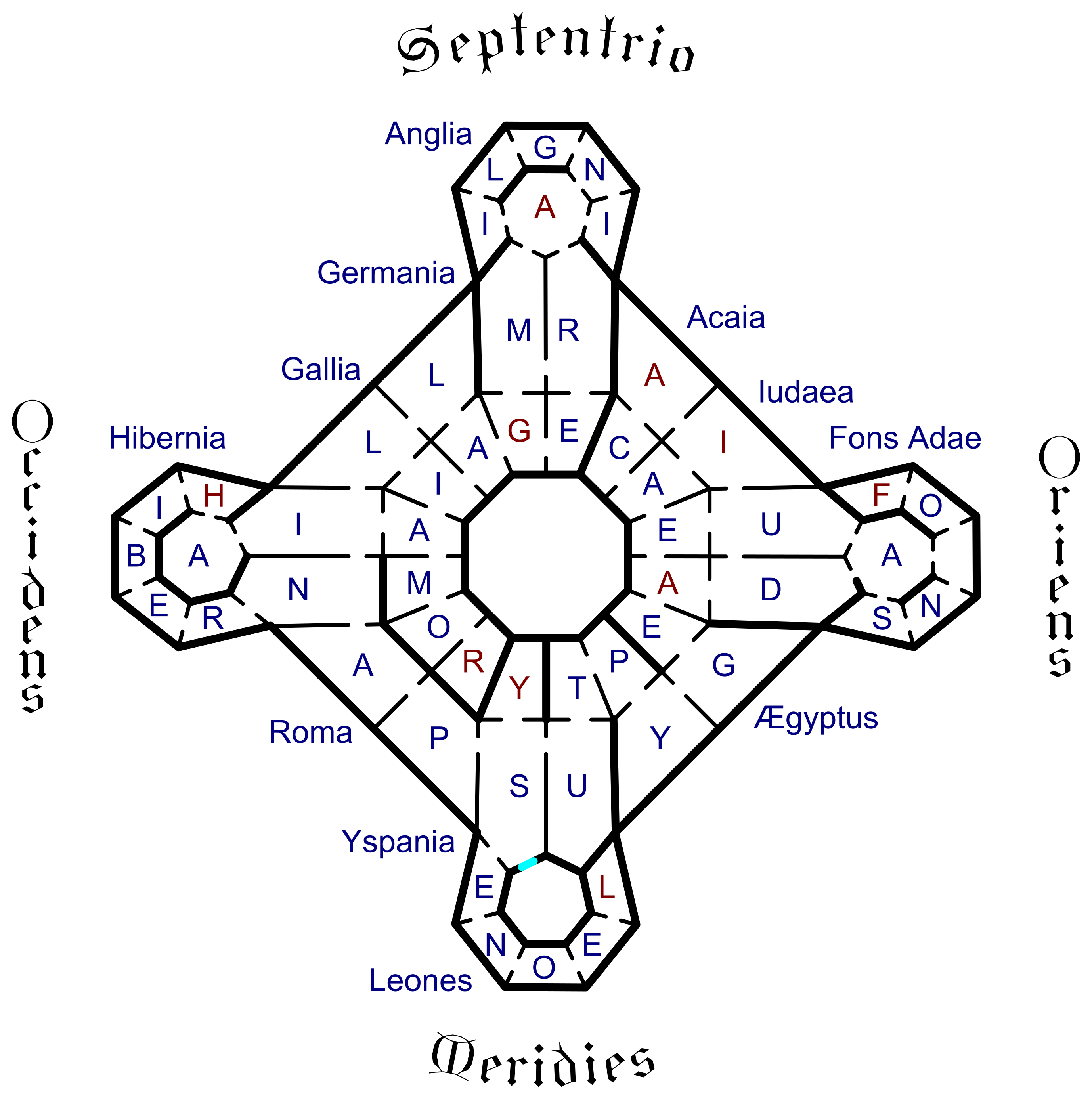
At the heart of Foucault’s Pendulum, however, there is a frustrated, middle-aged man of letters, an editor of academic books, Jacopo Belbo, who spends evening after evening in front of a computer typing more and more unhinged entries onto a screen, gradually self-radicalising and becoming increasingly convinced that the computer is somehow helping him, somehow guiding him to certain realisations, letting him discover the true connection of things. It is Eco’s most personal and prophetic parody, the source from which all his subsequent novels flowed and, arguably, the most insightful text about our own times. The computer is called Abulafia, and it understands the assignment a little too well and of course takes it all too far for everyone’s good.
(to be continued)